
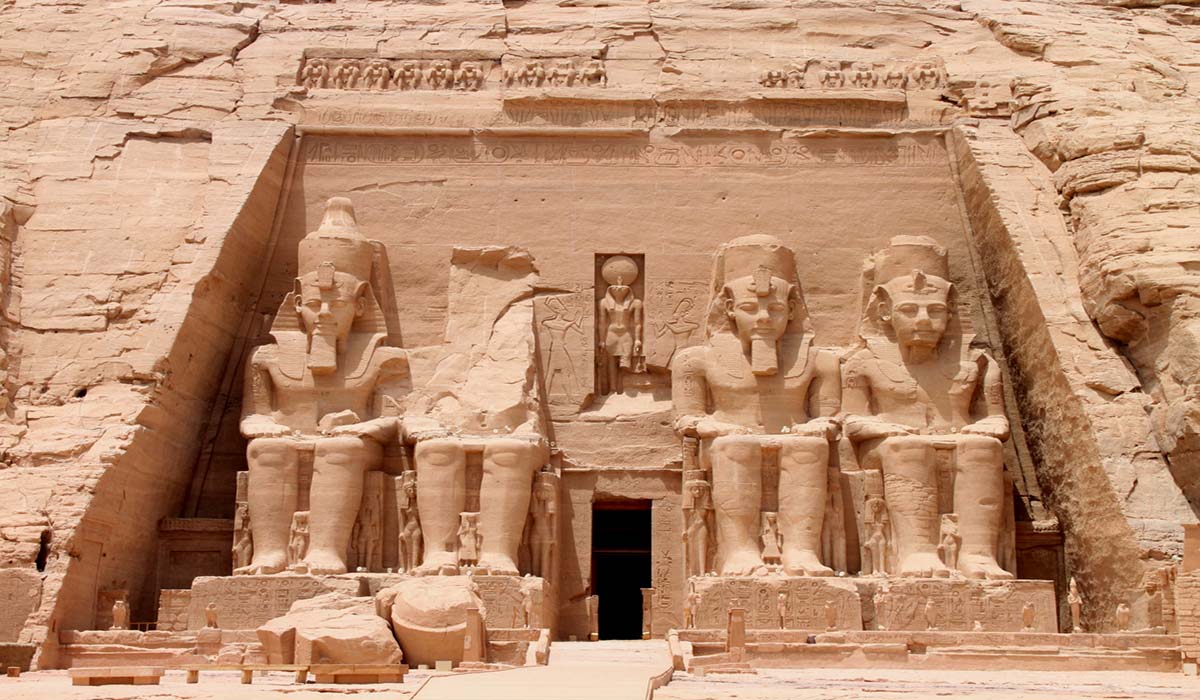
The Abu Simbel temples are two massive rock-cut temples at Abu Simbel (Arabic: أبو سمبل), a village in Aswan Governorate, Upper Egypt, near the border with Sudan. They are situated on the western bank of Lake Nasser, about 230 km (140 mi) southwest of Aswan (about 300 km (190 mi) by road). The complex is part of the UNESCO World Heritage Site known as the “Nubian Monuments”,[1] which run from Abu Simbel downriver to Philae (near Aswan). The twin temples were originally carved out of the mountainside in the 13th century BC, during the 19th Dynasty reign of the Pharaoh Ramesses II. They serve as a lasting monument to the king Ramesse II. His wife Nefertari and children can be seen in smaller figures by his feet, considered to be of lesser importance and were not given the same position of scale. This commemorates his victory at the Battle of Kadesh. Their huge external rock relief figures have become iconic.
The complex was relocated in its entirety in 1968 under the supervision of a Polish archaeologist, Kazimierz Michałowski, from the Polish Centre of Mediterranean Archaeology University of Warsaw,[2] on an artificial hill made from a domed structure, high above the Aswan High Dam reservoir. The relocation of the temples was necessary or they would have been submerged during the creation of Lake Nasser, the massive artificial water reservoir formed after the building of the Aswan High Dam on the River Nile. The project was carried out as part of the UNESCO Nubian Salvage Campaign.
Construction
During his reign, Ramesses II embarked on an extensive building program throughout Egypt and Nubia, which Egypt controlled. Nubia was very important to the Egyptians because it was a source of gold and many other precious trade goods. He, therefore, built several grand temples there in order to impress upon the Nubians Egypt’s might and Egyptianize the people of Nubia.[3][4] The most prominent temples are the rock-cut temples near the modern village of Abu Simbel, at the Second Nile Cataract, the border between Lower Nubia and Upper Nubia.[4] There are two temples, the Great Temple, dedicated to Ramesses II himself, and the Small Temple, dedicated to his chief wife Queen Nefertari.
Construction of the temple complex started in approximately 1264 BC and lasted for about 20 years, until 1244 BC. It was known as the “Temple of Ramesses, beloved by Amun“.
Rediscovery
With the passage of time, the temples fell into disuse and eventually became covered by sand. By the 6th century BC, the sand already covered the statues of the main temple up to their knees. The temple was forgotten until 1813, when Swiss orientalist Johann Ludwig Burckhardt found the top frieze of the main temple. Burckhardt talked about his discovery with Italian explorer Giovanni Belzoni, who travelled to the site, but was unable to dig out an entry to the temple. Belzoni returned in 1817, this time succeeding in his attempt to enter the complex. A detailed early description of the temples, together with contemporaneous line drawings, can be found in Edward William Lane‘s Description of Egypt (1825–1828).[5]
Relocation

In 1959, an international donations campaign to save the monuments of Nubia began: the southernmost relics of this ancient human civilization were under threat from the rising waters of the Nile that were about to result from the construction of the Aswan High Dam.

One scheme to save the temples was based on an idea by William MacQuitty to build a clear freshwater dam around the temples, with the water inside kept at the same height as the Nile. There were to be underwater viewing chambers. In 1962 the idea was made into a proposal by architects Jane Drew and Maxwell Fry and civil engineer Ove Arup.[6] They considered that raising the temples ignored the effect of erosion of the sandstone by desert winds. However, the proposal, though acknowledged to be extremely elegant, was rejected.
The salvage of the Abu Simbel temples began in 1964 by a multinational team of archeologists, engineers and skilled heavy equipment operators working together under the UNESCO banner; it cost some US$40 million at the time (equal to $300 million in 2017 dollars). Between 1964 and 1968, the entire site was carefully cut into large blocks (up to 30 tons, averaging 20 tons), dismantled, lifted and reassembled in a new location 65 metres higher and 200 metres back from the river, in one of the greatest challenges of archaeological engineering in history.[7] Some structures were even saved from under the waters of Lake Nasser. Today, a few hundred tourists visit the temples daily. Guarded convoys of buses and cars depart twice a day from Aswan, the nearest city. Many visitors also arrive by plane at an airfield that was specially constructed for the temple complex.
The complex consists of two temples. The larger one is dedicated to Ra-Harakhty, Ptah and Amun, Egypt’s three state deities of the time, and features four large statues of Ramesses II in the facade. The smaller temple is dedicated to the goddess Hathor, personified by Nefertari, Ramesses’s most beloved of his many wives.[8] The temple is now open to the public.

Comment (0)